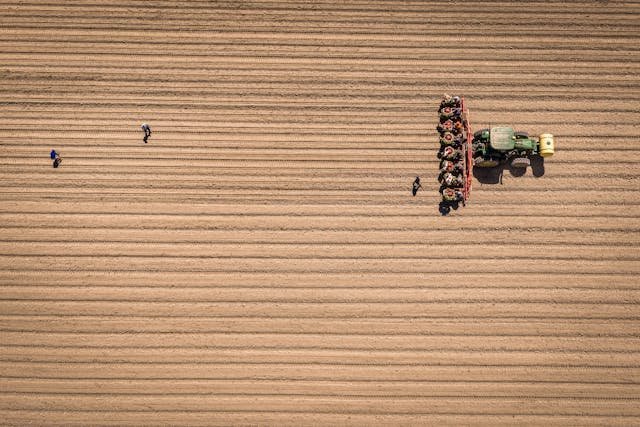
The agricultural industry is in the midst of a digital revolution. From satellite-guided tractors to AI-powered crop monitoring, digital platforms are fundamentally changing how food is produced, managed, and distributed. The global precision agriculture market was valued at $9.5 billion in 2025 and is projected to nearly double by 2031, reflecting a structural shift in how farms operate worldwide. For agricultural professionals seeking to stay competitive, understanding the digital platform landscape is no longer optional, but essential.
Contents
- 1 The Rise of Digital Agriculture
- 1.1 Related posts
- 1.2 What Economic Trends Are Shaping the Year 2026?
- 1.3 Top ORM Israeli Agencies for 2026: Complete Ranking Guide
- 1.4 Global Esports Momentum Drives Investor Optimism as GameSquare Shares Climb on Growth Prospects
- 1.5 Boost Your B2B Sales Pipeline: Book a Free Consultation with Clutch-Recognized SalesAR
- 1.6 How Thinking Errors Hinder Business Growth – And How to Overcome Them
- 1.7 What is Regulatory Arbitrage and How to Avoid Scams
- 1.8 Bridging the Gap Between Workforce Management and Business Efficiency: The Snow Technology Solution
- 2 Comparison of Leading Digital Agriculture Platforms
- 3 Key Capabilities That Define Top Platforms
- 4 The Role of AI in Agricultural Platforms
- 5 Integration Across the Agricultural Value Chain
- 6 Data Ownership and Security Considerations
- 7 Choosing the Right Digital Agriculture Platform
- 8 The Future of Digital Agriculture
The Rise of Digital Agriculture
Digital agriculture encompasses the entire spectrum of technologies that digitize and automate farming tasks: farm management software, precision agriculture tools, remote sensing systems, IoT-connected devices, AI-driven analytics, and supply chain platforms. According to the FAO Digital Agriculture Unit, digital technologies and artificial intelligence are catalyzing unprecedented opportunities to transform agrifood systems worldwide from precision farming and climate-smart agriculture to supply chain optimization and market access.
The practical significance for farmers and agribusinesses is that these technologies are no longer experimental curiosities but proven tools that directly impact profitability, sustainability, and resilience against climate variability. The challenge for most operations today is not whether to adopt digital tools, but which platforms to choose and how to integrate them effectively.
Comparison of Leading Digital Agriculture Platforms
The digital agriculture ecosystem includes platforms that serve different segments of the value chain. Here is how the leading platforms compare across key capabilities:
[Phenome Networks](https://phenome-networks.com/en/) — A comprehensive data management platform specializing in phenomics and breeding analytics. It offers end-to-end research and production workflow management with advanced AI-driven analysis, excelling in multi-environment data integration, cross-program collaboration, and scalable architecture that serves both research institutions and large commercial operations. Cloud-native with robust API connectivity.
Climate FieldView (Bayer) — One of the most widely deployed digital farming platforms globally. Provides field-level data collection, yield analysis, and variable-rate prescription maps with strong integration across major equipment brands. Primarily focused on row crop operations in North America.
Cropin Cloud — Positioned as an intelligent agriculture cloud offering satellite-based monitoring, predictive analytics, and supply chain visibility. Strong presence in emerging markets with solutions for smallholder farmers and agribusinesses across diverse geographies.
AGRIVI — A comprehensive digital agriculture solution covering farm planning, crop monitoring, financial management, and compliance. Widely used in European markets with strong sustainability reporting and organic certification workflows.
CropX — An agronomic farm management system combining hardware soil sensors with software analytics. Specializes in irrigation management, soil health monitoring, and variable-rate application recommendations, particularly effective for water-efficiency-focused operations.
Farmonaut — A satellite-based crop monitoring platform designed for accessibility. Offers affordable subscription plans that democratize precision agriculture tools previously limited to large operations, extending reach to smallholders and mid-sized farms through mobile devices.
Key Capabilities That Define Top Platforms
The most effective digital agriculture platforms share several critical capabilities. Data integration stands at the top: the ability to combine information from soil sensors, weather stations, satellite imagery, equipment telemetry, and manual observations into a unified analytical framework. Real-time monitoring enables farmers to detect problems pest infestations, nutrient deficiencies, water stress before they escalate into yield-limiting issues.
Predictive analytics use historical and current data to forecast outcomes and recommend optimal actions. Scalability ensures the platform can grow with the operation, handling increasing data volumes and expanding geographic coverage without performance degradation. Platforms that fail on any of these dimensions typically create more management burden than they eliminate.
The Role of AI in Agricultural Platforms
Artificial intelligence has become the distinguishing feature of next-generation agricultural platforms. Machine learning models analyze satellite imagery to detect crop stress patterns invisible to the naked eye. Natural language processing enables farmers to query their data through conversational interfaces rather than complex dashboards. Computer vision automates plant counting, disease identification, and phenotypic measurement.
According to FAO’s guidance on precision agriculture for smallholder farmers, advances in digital technologies such as mobile phones, remote sensing via satellite, unmanned aerial vehicles, IoT, and AI are making precision agriculture applications increasingly accessible even to smallholder farmers in developing countries. Only 27 percent of U.S. farms used precision agriculture practices as of 2023, despite technologies being available since the 1990s, indicating enormous room for growth as AI-powered platforms simplify adoption and reduce the technical knowledge required to extract value from data.
Integration Across the Agricultural Value Chain
The most impactful digital platforms extend beyond the farm gate. Supply chain visibility tools track produce from field to consumer, enabling traceability that satisfies regulatory requirements and commands premium prices in quality-conscious markets. Financial management features help farmers optimize input purchases, manage cash flow, and prepare documentation for lenders and insurers.
Compliance modules automate reporting for sustainability certifications, organic standards, and government programs. The platforms that deliver the most value are those that connect these functions into a seamless workflow, rather than requiring farmers to use separate tools for each task.
What Research Institutions and Seed Companies Need
Research-oriented organizations and seed companies have requirements that differ substantially from commercial farm operations. They need platforms that excel in phenotypic data management across multiple trial environments, pedigree tracking, genomic data integration, and cross-location collaboration. The ability to manage large, complex datasets across geographies and growing seasons, while maintaining data integrity and enabling statistical analysis is what separates specialized platforms from general farm management tools.
This is the domain where Phenome Networks delivers its strongest differentiation: purpose-built architecture for phenomics and breeding data, designed for the rigorous data management requirements of professional breeding programs.
Data Ownership and Security Considerations
As farms generate increasingly valuable data, questions of ownership and security become critical. Farmers should understand who owns the data they upload to a platform, whether the provider can share aggregated data with third parties, and what happens to data if they cancel their subscription. The most transparent platforms clearly state that farmers retain full ownership of their data and provide straightforward export mechanisms.
Encryption, access controls, and compliance with data protection regulations are baseline expectations that any serious platform must meet. These considerations should be part of the platform evaluation process, not an afterthought once the contract is signed.
Choosing the Right Digital Agriculture Platform
Selecting a digital agriculture platform requires matching the tool to the operation’s specific needs. Large-scale commercial farms benefit from comprehensive platforms with strong equipment integration and advanced field analytics. Smallholder farmers in developing markets prioritize affordability, mobile accessibility, and low-bandwidth functionality.
The decision should also consider the platform’s ecosystem: which hardware integrations are supported, what third-party tools can connect via API, and how easily data can be exported if the operation switches providers in the future. Total cost of ownership including implementation, training, and ongoing support, often differs substantially from headline subscription pricing.
The Future of Digital Agriculture
The trajectory of digital agriculture points toward increasingly autonomous systems. Self-driving equipment guided by AI, robotic harvesters that selectively pick ripe produce, and drone fleets that autonomously scout and treat fields are moving from prototype to production. The digital platforms of today are building the data foundations these autonomous systems will rely on tomorrow.
Organizations that invest in digital infrastructure now are positioning themselves not just for current efficiency gains but for compatibility with the transformative technologies that will define agriculture over the coming decade. The farms that win in that future will be those that started building their data assets today.
Also read this – What Economic Trends Are Shaping the Year 2026?